The Future of AI-Powered Development
AI-assisted development is not replacing developers but amplifying their capabilities, shifting the role from code author to system architect and quality conductor.
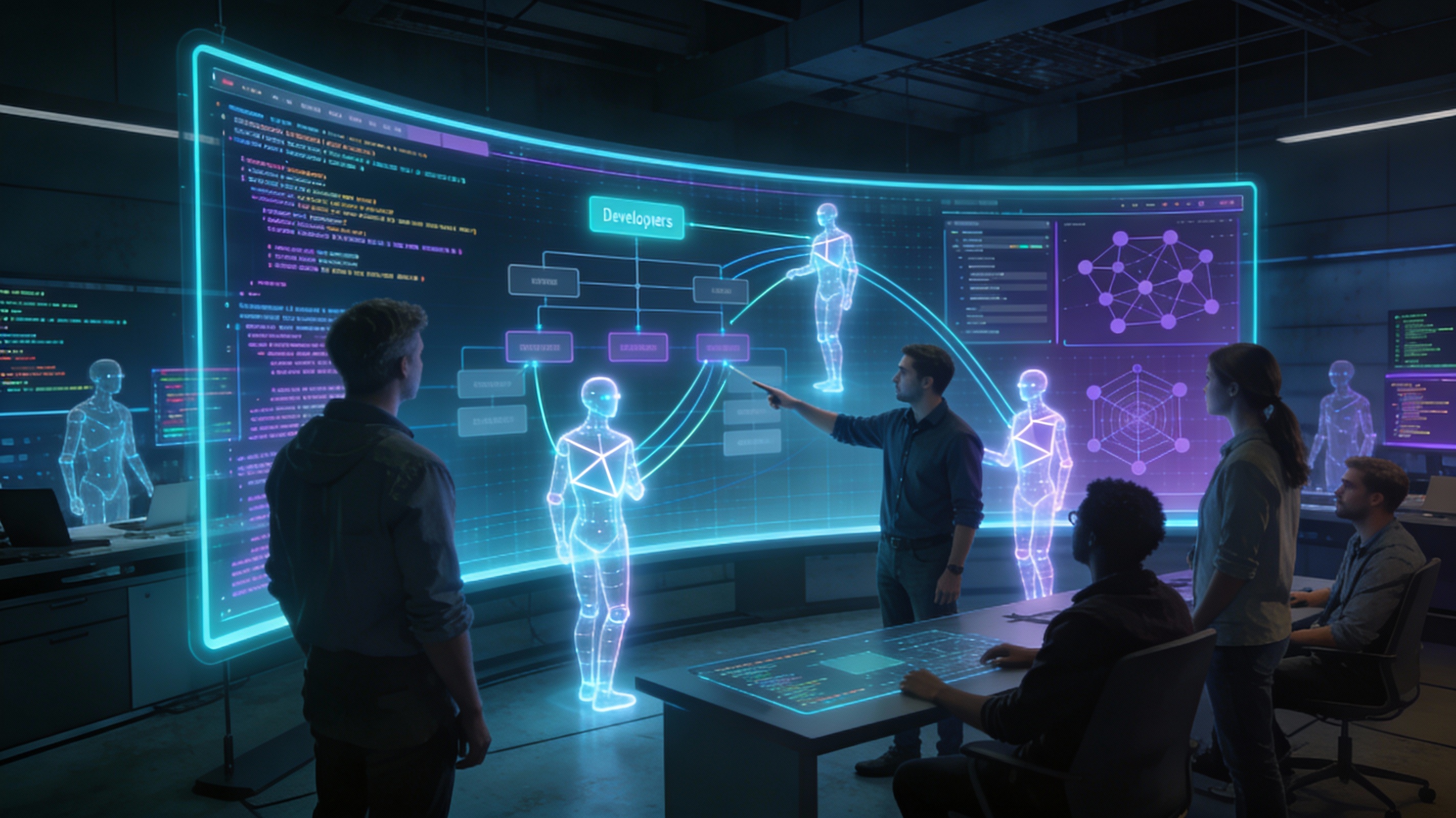
AI-assisted development transforms coding from mechanical tasks to strategic orchestration
The Current State of AI Development
The software development landscape is undergoing a fundamental transformation. GitHub Copilot, Claude Code, and similar tools have moved beyond novelty to become essential components of modern development workflows. According to GitHub’s research, developers using AI assistants complete tasks up to 55% faster on average, with significant improvements in code quality and developer satisfaction1.
What makes this shift particularly notable is not just the speed improvement, but the change in how developers spend their time. The mechanical aspects of coding—syntax memorization, boilerplate generation, routine refactoring—are increasingly automated, freeing engineers to focus on higher-level architectural decisions.
Beyond Code Completion
The next generation of AI development tools goes far beyond simple autocomplete. We’re seeing the emergence of systems that understand project context, suggest architectural patterns, identify potential security vulnerabilities before they reach production, and even generate entire test suites.
These tools operate at multiple levels of abstraction:
- System Design — AI can now suggest component interactions, database schemas, and API designs based on requirements
- Code Generation — From single functions to entire modules, AI produces working code that follows project conventions
- Testing and Quality — Automated test generation, static analysis, and even automated bug fixing
- Documentation — Self-documenting code, automatic API documentation, and contextual explanations
The Human-AI Partnership
The most effective development teams are not those replacing humans with AI, but those finding the optimal balance between human creativity and AI capability. The metaphor shifting from “programmer” to “conductor” captures this evolution well.
Human strengths remain critical:
- Strategic Thinking — Understanding business context, user needs, and long-term maintainability
- Creative Problem Solving — Novel approaches to genuinely new challenges
- Code Review Judgment — Assessing whether generated code aligns with project values
- Team Dynamics — Mentoring, knowledge sharing, and collaborative design
What This Means for Software Teams
Organizations adopting AI-assisted development report not just productivity gains, but fundamental changes in team structure and skill requirements. Junior developers can contribute meaningfully earlier in their careers, while senior engineers focus on architecture and mentorship.
The implications for hiring and career development are significant. The barrier to entry for basic development tasks is lowering, but the ceiling for impactful contribution is raising. The most valuable engineers will be those who can effectively leverage AI tools while providing the strategic judgment that remains uniquely human.
Preparing for the AI-Augmented Future
For individual developers and organizations alike, preparing for this future requires deliberate investment. Technical skills remain important, but are increasingly table stakes. The differentiating capabilities are:
- System Architecture — Understanding how components fit together at scale
- AI Collaboration — Learning to prompt effectively, evaluate AI output critically, and iterate productively
- Domain Expertise — Deep knowledge of specific industries or problem spaces
- Communication — Translating between technical possibilities and business needs
The future of development is not human versus AI, but human plus AI—each amplifying the other’s strengths.
Related
- Demoing Gastown with Cody Article Writer Skill - How this article was created using AI tools
- Gastown - Multi-agent orchestrator used in the workflow
- Cody Article Writer - AI writing skill that produced this article
Tags: AI Development, Developer Productivity, Human-AI Collaboration
GitHub Research, “Quantifying GitHub Copilot’s impact on developer productivity and happiness,” September 2022. https://github.blog/2022-09-07-research-quantifying-github-copilots-impact-on-developer-productivity-and-happiness/ ↩︎